Auditor approved by the Secretariat of Energy
We audit facilities that store and dispense hydrocarbons as an entity listed directly in the Register of Auditing Entities: no intermediaries, with our own technical representatives and our own equipment.
Audits and inspections under Secretariat of Energy resolutions
Each service answers to a resolution and a type of asset. Audits require the relevant listing in the Register of Auditing Entities; API 653 integrity inspections require a professional certified to that standard.
The regulatory framework of each audit
The Secretariat of Energy maintains the Register of Auditing Entities created by Resolución 414/2021. Compañía Técnica is registered under number 204142026 for categories A-I, A-II, B-I and B-II, with its own technical representatives registered before the enforcement authority. That listing is what gives the report legal standing: a well-executed check by an unregistered company is of no use for the official file.
The surface safety audit answers to Resolución 404/1994, which is the one the facility operator must comply with. Underground tank tightness falls under category B-II of the Register and covers retail outlets and any facility with underground storage tanks. They are two different things and are often confused: 414/2021 approves the auditor, 404/1994 obliges the operator.
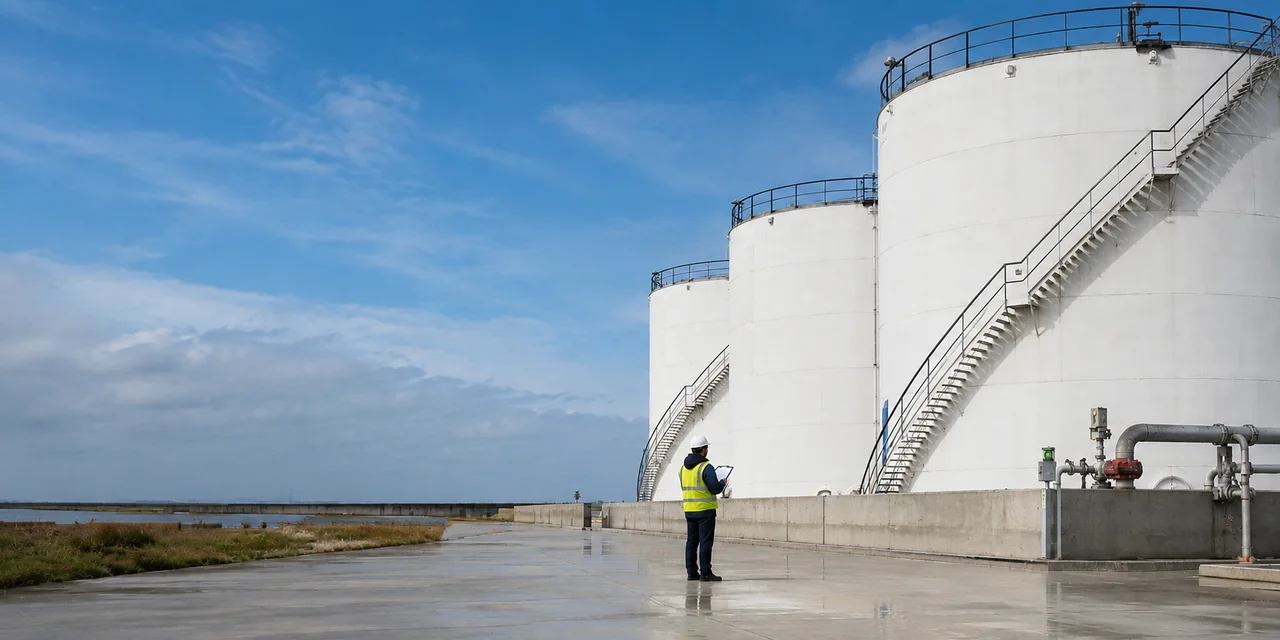
Resolución 277/2025 requires integrity inspections to API 653 for vertical aboveground hydrocarbon tanks of 50 m³ or more, performed by an API 653 certified professional. For horizontal and smaller tanks, the operator must ensure and monitor integrity according to the original design. Registration has a different scope: individual tanks of 50 m³ or more, or sites with a total capacity of 100 m³ or more, which must register tanks of 5 m³ or more.
Need to measure or inspect an asset?
We also detect discontinuities, measure thickness and assess the integrity of equipment without taking it out of service: ultrasonics, magnetic particle, dye penetrant and MFL scanning.
See non-destructive testingFrequently asked questions about audits
How often does the facility have to be audited?
It depends on the type of asset, its capacity and when the last inspection took place. For aboveground tanks, Resolución 277/2025 set the deadlines on the basis of those three facts. The schedule that applies to your facility is determined during the preliminary technical visit, together with the scope of the audit, and is recorded in the report for the next due date.
How do I verify that an auditor is actually registered?
The Register is public: the Secretariat of Energy publishes the report of registered entities, where Compañía Técnica appears approved under Register No. 204142026 for categories A-I, A-II, B-I and B-II. Each registration is formalised through an administrative act, and the report is signed by a technical representative registered with the enforcement authority.
Which audit or inspection does my facility need?
It depends on the asset. A service station with buried tanks needs the surface safety audit and underground tank tightness. Vertical aboveground hydrocarbon tanks of 50 m³ or more require integrity inspections to API 653 under Resolución 277/2025. One facility may need more than one.
What does being approved for all four categories mean?
That a single provider can audit anything from a refinery to a retail outlet. Many auditors hold only one or two categories, so an operator with different types of facility ends up hiring several. The four categories cover refineries, large plants and biofuels, self-consumption facilities, and retail outlets with underground tanks.
Does the audit include the testing, or is that hired separately?
The audit covers the checks its scope requires and is hired as a single service. Non-destructive testing is a separate line of work, which can be hired on its own when what you need is to measure rather than to audit.