Industrial Ultrasonic Testing (UT)
We detect internal flaws, measure thicknesses and assess the degree of corrosion in your industrial assets with maximum precision and without affecting the integrity of the material.
+20 years
of experience
What is ultrasonic testing?
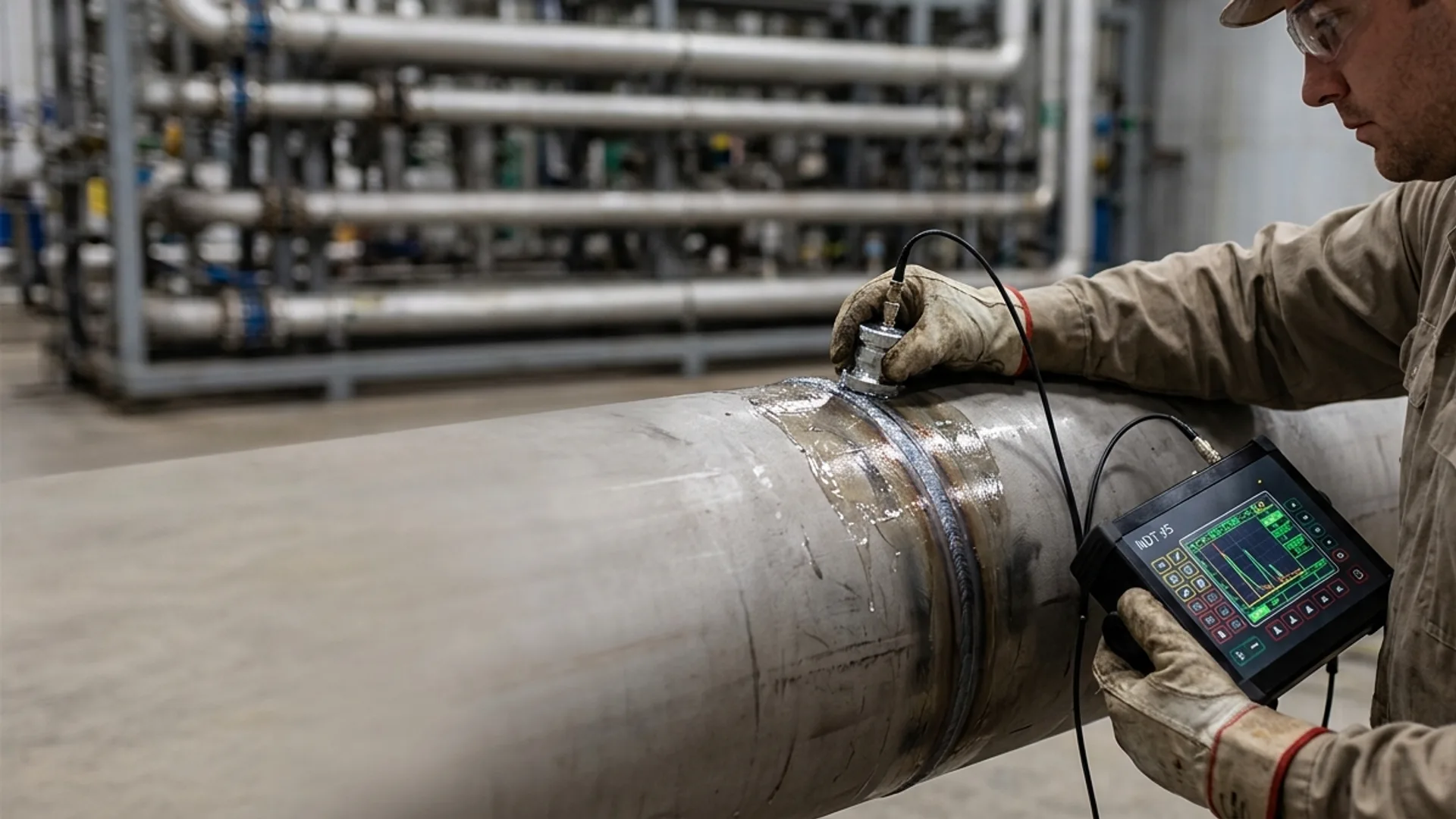
Ultrasonic testing (UT) is one of the most widely used non-destructive testing (NDT) techniques in industry for assessing the integrity of materials and components without causing any damage. The technique is based on propagating high-frequency sound waves (typically between 0.5 and 25 MHz) through the material under inspection.
When the ultrasonic waves meet a discontinuity such as a crack, inclusion, porosity or a change in material thickness, part of the energy is reflected back to the transducer. The ultrasonic instrument processes those reflected signals and displays them on screen, letting the certified technician determine the location, size and nature of any defect present.
At Compañía Técnica we have latest-generation ultrasonic equipment and technicians certified to IRAM-ISO 9712 at levels II and III, which guarantees precise, reliable results to protect your industrial assets.
Benefits of industrial ultrasonic testing
See why ultrasonic testing is the preferred technique for structural integrity inspection
Non-destructive
Inspection without affecting the integrity of the material
High precision
Detection of defects from 0.5 mm in diameter
Immediate results
Real-time assessment during the inspection
Certified personnel
IRAM-ISO 9712 Level II and III technicians
Thickness measurement
±0.1 mm precision in measurements
Industrial versatility
Applicable across multiple sectors and materials
Applications of ultrasonic testing
Ultrasonic testing is versatile and applies across a wide range of components and industrial sectors:
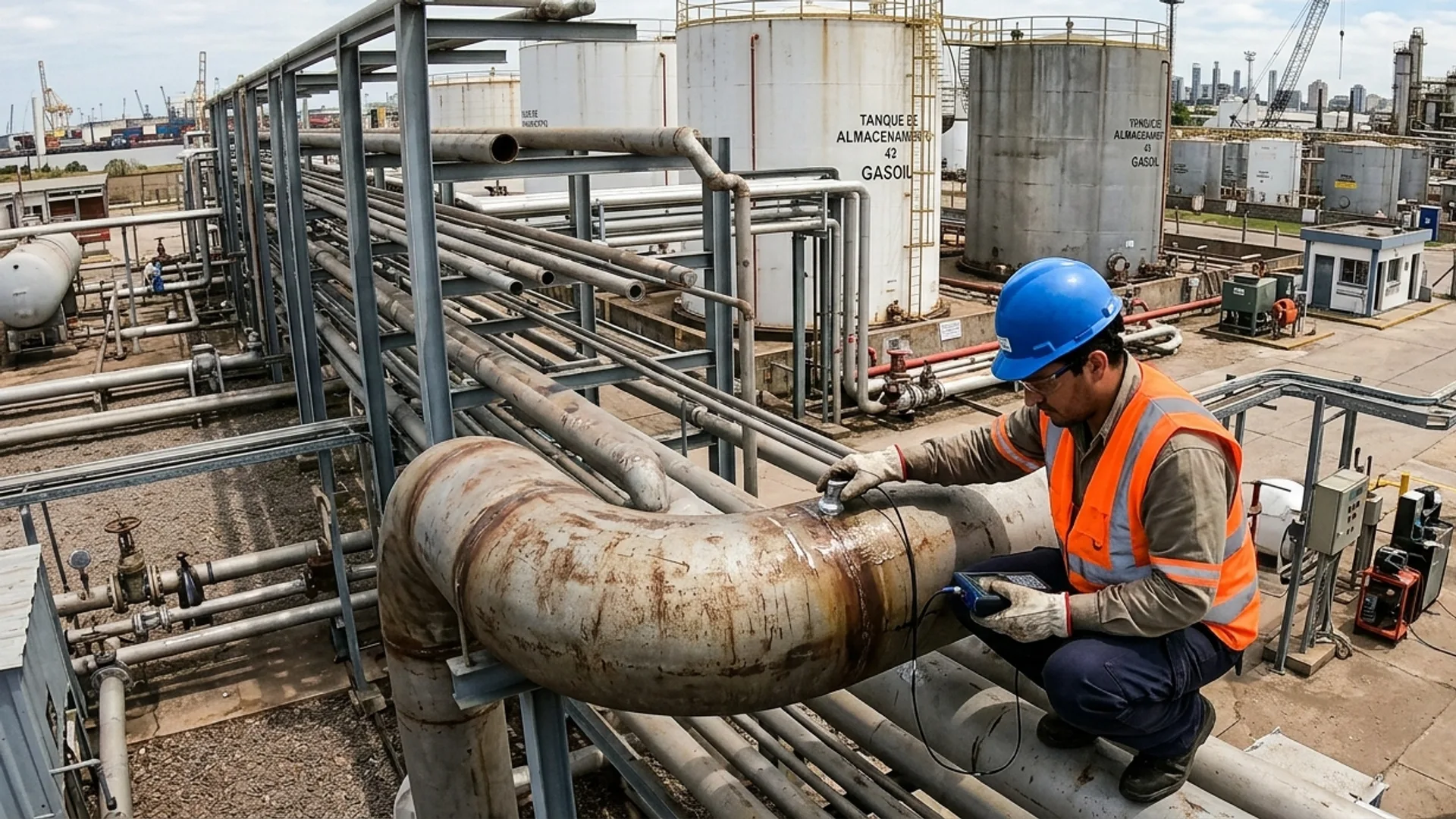
- Weld inspection on storage tanks
- Thickness measurement on pipework and pressure vessels
- Detection of corrosion under insulation (CUI)
- Integrity assessment of metal structures
- Quality control in component manufacturing
- Inspection of boilers and heat exchangers
- Verification of welded joints in critical structures
- Wear monitoring on rotating equipment
Frequently asked questions about ultrasonic testing
What is industrial ultrasonic testing?
Ultrasonic testing (UT) is a non-destructive testing technique that uses high-frequency sound waves to detect internal discontinuities, measure material thicknesses and assess the state of corrosion in industrial components without damaging them.
What kinds of defects can ultrasonic testing detect?
Ultrasonic testing can detect cracks, porosity, inclusions, laminations, lack of fusion in welds, internal corrosion, thickness loss and delamination in metallic and composite materials.
Which industries use ultrasonic testing?
It is used in oil and gas, petrochemicals, power, shipbuilding, aerospace, automotive, mining, and any industry that needs to verify the structural integrity of metal components.
What certifications do your ultrasonic technicians hold?
Our technicians are certified to IRAM-ISO 9712 at levels I, II and III, guaranteeing the highest technical competence in carrying out and interpreting ultrasonic tests.
What is the difference between conventional ultrasonics and phased array?
Conventional ultrasonics uses a single transducer element, while phased array uses multiple elements that allow faster scanning, variable angular coverage and improved graphical representation of the defects detected.
Related services
Reference standards
- IRAM — IRAM-ISO 9712 standard for the qualification of NDT personnel
- American Society for Nondestructive Testing (ASNT) — international reference on NDT methods and qualification
- American Petroleum Institute (API) — publisher of the API 653, API 1104 and API 579 standards