Liquid Penetrant Testing (PT) on components and welds
We reveal cracks, porosity, laps and lack of fusion open to the surface in ferrous and non-ferrous materials, with penetrant, developer and acceptance criteria to ASTM E165 and ISO 3452.
- Discontinuities open to the surface on non-porous materials
- Applicable to stainless steel, aluminium, copper, bronze and titanium
- Sequence and sensitivity level to ASTM E165 and ISO 3452
- Testing on site or in the workshop, with no magnetisation of the part
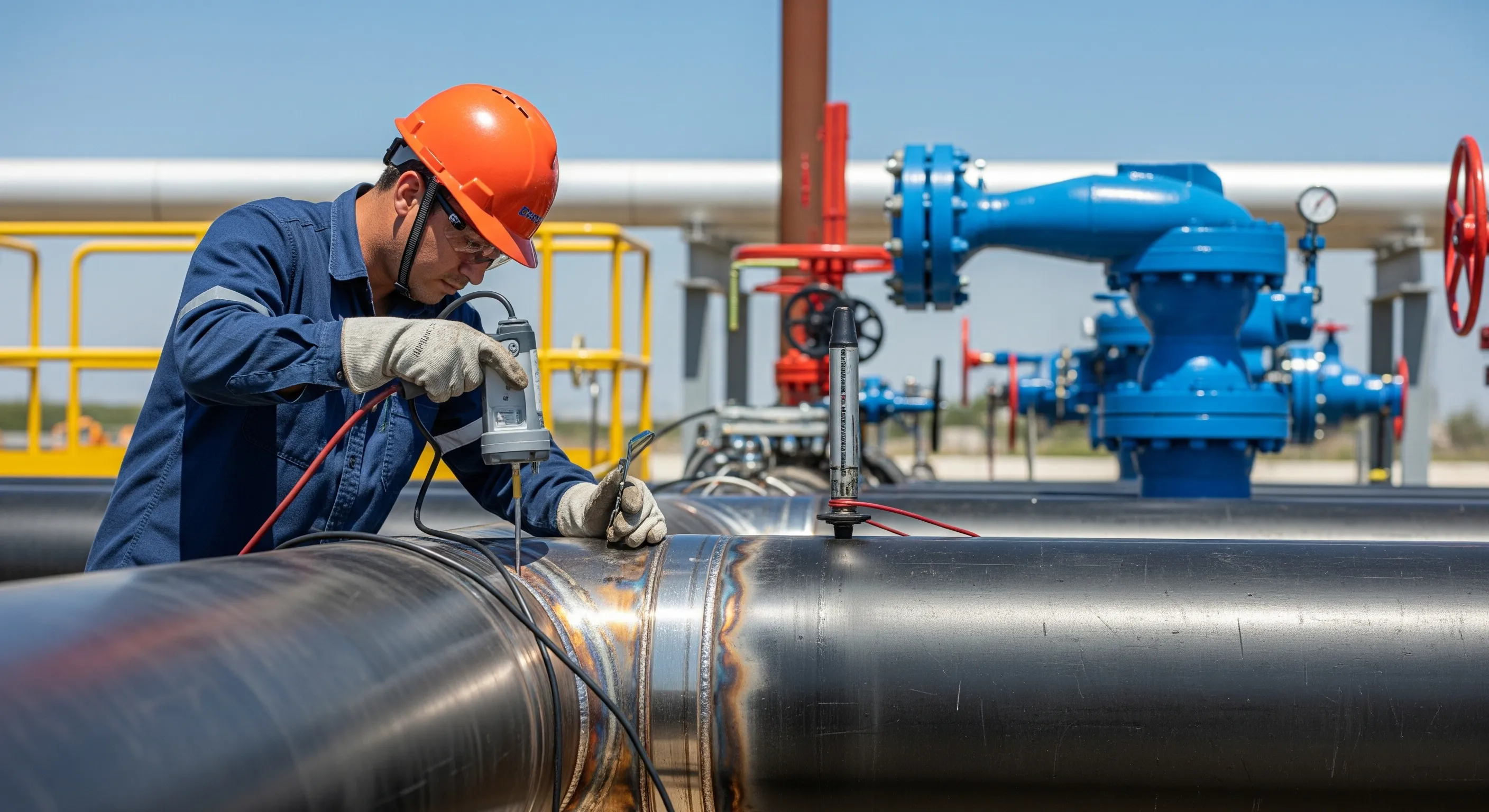
PT
Dye penetrant
What is liquid penetrant testing?
Liquid penetrant testing (PT), also called dye penetrant testing, reveals discontinuities open to the surface on non-porous materials, both ferrous and non-ferrous. A high-capillarity liquid is applied to the cleaned surface and enters the discontinuity, the excess is removed, and a developer draws the trapped penetrant back out: the indication appears with a contrast that widens the actual flaw until it becomes visible.
It is the method of choice when the material is not ferromagnetic and therefore cannot be examined with magnetic particles: austenitic stainless steels, aluminium, copper, bronze, titanium and nickel alloys. On carbon steels both methods apply, and the choice depends on whether the discontinuity being looked for is only at the surface or also sub-surface.
The result depends on surface preparation: paint, scale, slag or grease block the penetrant and produce false indications, so the test begins with cleaning the area to be examined. Execution and interpretation are carried out by technicians certified to IRAM-ISO 9712, and the report records the location, type and size of every indication together with its classification against the acceptance criteria of the applicable code.
What liquid penetrant testing delivers
A surface method that needs neither electrical current nor magnetisation of the component
Surface detection
Cracks, porosity, laps and lack of fusion open to the surface of the material.
Read on the spot
The indication develops during the test, with no samples sent to a laboratory.
Report with acceptance criteria
Location, type and size of each indication against the applicable code.
Qualified personnel
Testing and interpretation by technicians certified to IRAM-ISO 9712.
Frequently asked questions about liquid penetrant testing
What does liquid penetrant testing detect?
It detects discontinuities open to the surface on non-porous materials: fatigue cracks, shrinkage cracks, porosity, rolling laps, lack of fusion and lack of penetration in welds. It does not reach internal defects or closed discontinuities, which call for a volumetric method such as ultrasonic testing.
Which materials can it be applied to?
Any non-porous material, ferrous or non-ferrous: carbon steels, austenitic stainless steels, aluminium, copper, bronze, titanium, nickel and their alloys, as well as glazed ceramics and plastics that are not attacked by the penetrant. It cannot be used on porous materials, or on surfaces with paint, coatings or scale that stop the liquid from entering.
When is penetrant testing preferable to magnetic particle testing?
Liquid penetrant testing is the method of choice when the material is not ferromagnetic and therefore cannot be magnetised: austenitic stainless steels, aluminium, copper or titanium. On ferromagnetic materials such as carbon steels, magnetic particle testing also reveals sub-surface discontinuities, whereas liquid penetrant testing is limited to those open to the surface.
What is the test sequence?
Surface cleaning, penetrant application and dwell time, removal of the excess, developer application, and evaluation of the indications once the development time has elapsed. After the evaluation the part is given a final cleaning. The sequence, the dwell times and the sensitivity level follow ASTM E165 and ISO 3452.
Which standards and acceptance criteria apply?
The procedure follows ASTM E165 and ISO 3452. Acceptance criteria come from the construction or in-service code of the component: ASME Section V for the method and ASME Section VIII for pressure vessels are the most common. Personnel qualification follows IRAM-ISO 9712, in line with ASNT recommended practice.
Related services
Reference standards
- IRAM — IRAM-ISO 9712 standard for the qualification of NDT personnel
- American Society for Nondestructive Testing (ASNT) — international reference on NDT methods and qualification
- ASME — boiler and pressure vessel code and welding qualification