Private auditor authorised by Argentina's Energy Secretariat (Res. 414/2021) · Categories A-I, A-II, B-I and B-II
Tightness testing on underground tanks (SASH)
We verify the tightness of underground hydrocarbon storage tanks (SASH) and their associated pipework, with our own equipment and under the technical responsibility of our representatives registered with the Energy Secretariat.
- Testing on underground tanks, pipework and connections
- Measurement with pressure gauges, vacuum gauges and vacuum equipment
- Technical report with the measurements and site observations
- Auditor listed directly in the Energy Secretariat's Register
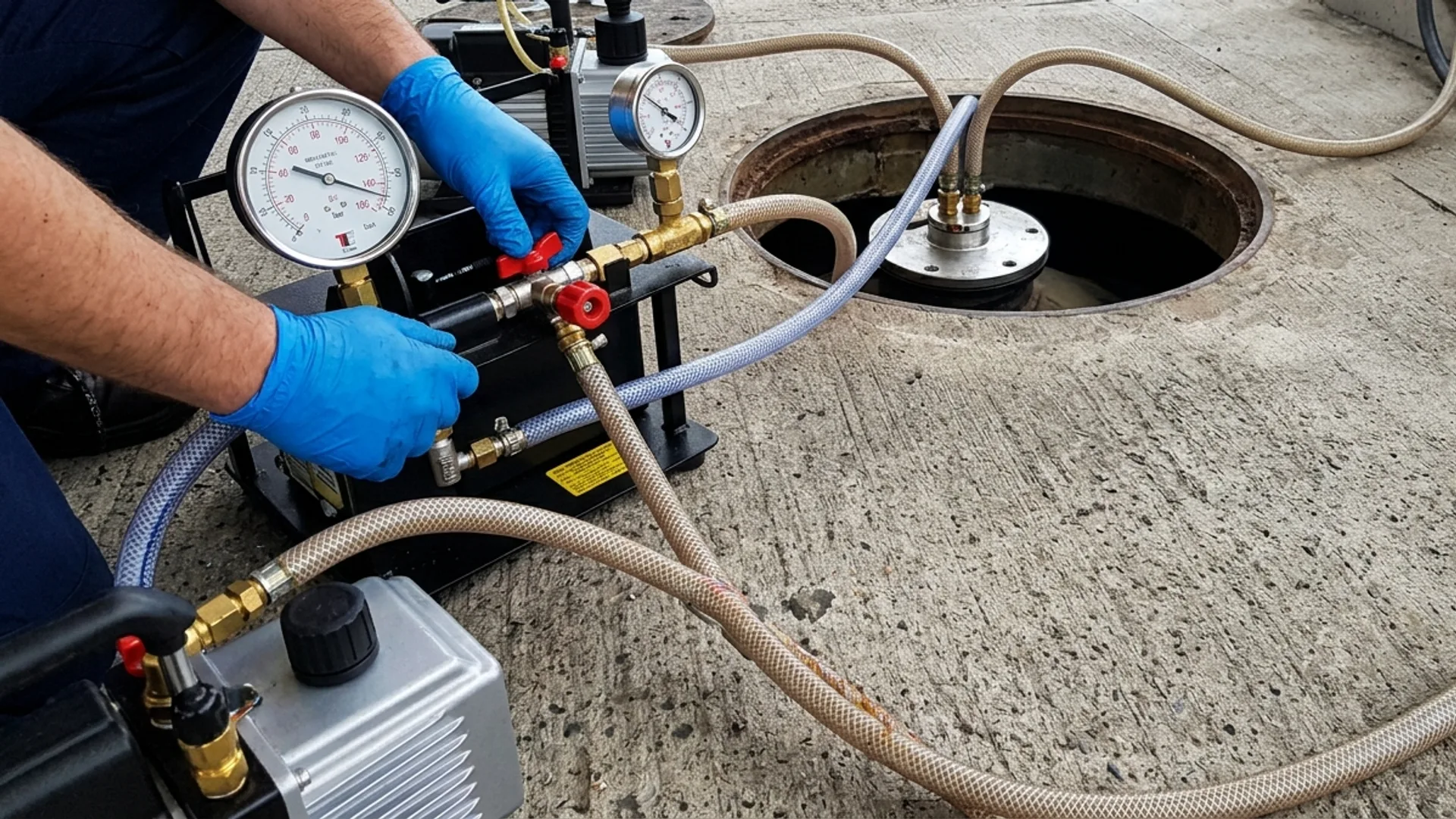
SASH
Tightness and leaks
What is tightness testing on a SASH?
An Underground Hydrocarbon Storage System (SASH in Spanish) is the set of buried tanks, pipework and connections that supplies a retail outlet or a plant. Being below ground, a leak can go unnoticed for a long time and end in soil and groundwater contamination, on top of the operational risk and the lost product.
The tightness test puts the system under controlled pressure or vacuum and verifies that it holds steady for the duration of the test. Any variation indicates a leak and makes it possible to locate the affected section before it becomes an incident.
Compañía Técnica performs these tests as an entity listed in the Energy Secretariat's Register of Auditing Entities of the Secretariat of Energy (Resolución 414/2021), authorised for categories A-I, A-II, B-I and B-II. Category B-II specifically covers tightness audits at liquid fuel retail outlets and other installations with underground storage tanks. We work with our own calibrated equipment, with no intermediary between running the test and signing the report.
Scope of the test
Tightness, leak control and verification of the system's integrity
Underground tanks
- Tightness testing on the tank
- Vacuum tightness verification
- Checks on fill points and vents
- Record of the measurements obtained
Pipework and connections
- Leak control on supply and return pipework
- Verification of joints, flanges and fittings
- Measurement with pressure and vacuum gauges
- Identification of the affected section when a leak appears
Documentation
- Technical report with methodology and results
- Photographic record of what was observed
- Signature of a registered technical representative
- Evidence for tracking the installation over time
Frequently asked questions about tank tightness
What is a SASH?
It is an Underground Hydrocarbon Storage System: the set of buried tanks, pipework, connections and fittings that stores and distributes fuel at a service station or plant. Because it is out of sight, it needs periodic testing to verify there are no leaks.
Does the test require the station to stop trading?
The test requires the system to be out of service while it runs, but scheduling is planned to keep the impact down: work is generally done tank by tank or sector by sector, and in many cases it can be booked for low-demand hours. Scope and timing are set during the technical visit.
What happens if the test finds a leak?
The report records the leak found and the section affected. From there the installation must carry out the corresponding repair. Once repaired, the test is repeated to verify the system holds.
What documentation is delivered?
A technical report covering the methodology applied, the equipment used, the measurements recorded and the site observations, signed by a technical representative registered with the Energy Secretariat.
Why hire a directly authorised auditor?
Because running the test and taking technical responsibility for the report stay with the same entity: there are no intermediaries, response times drop, and the audit stays traceable end to end.
Related services
Reference standards
- Register of Auditing Entities — Secretariat of Energy — the official public report listing Compañía Técnica as a registered entity
- Official Gazette of the Argentine Republic — published text of Resolutions 414/2021 and 277/2025
- IRAM — IRAM-ISO 9712 standard for the qualification of NDT personnel