
service lifepredictive maintenance
Keys to Asset Life Extension Through NDT
Discover how a well-planned Non-Destructive Testing program can maximize the service life of your equipment, reduce costs, and prevent unexpected failures.
Read more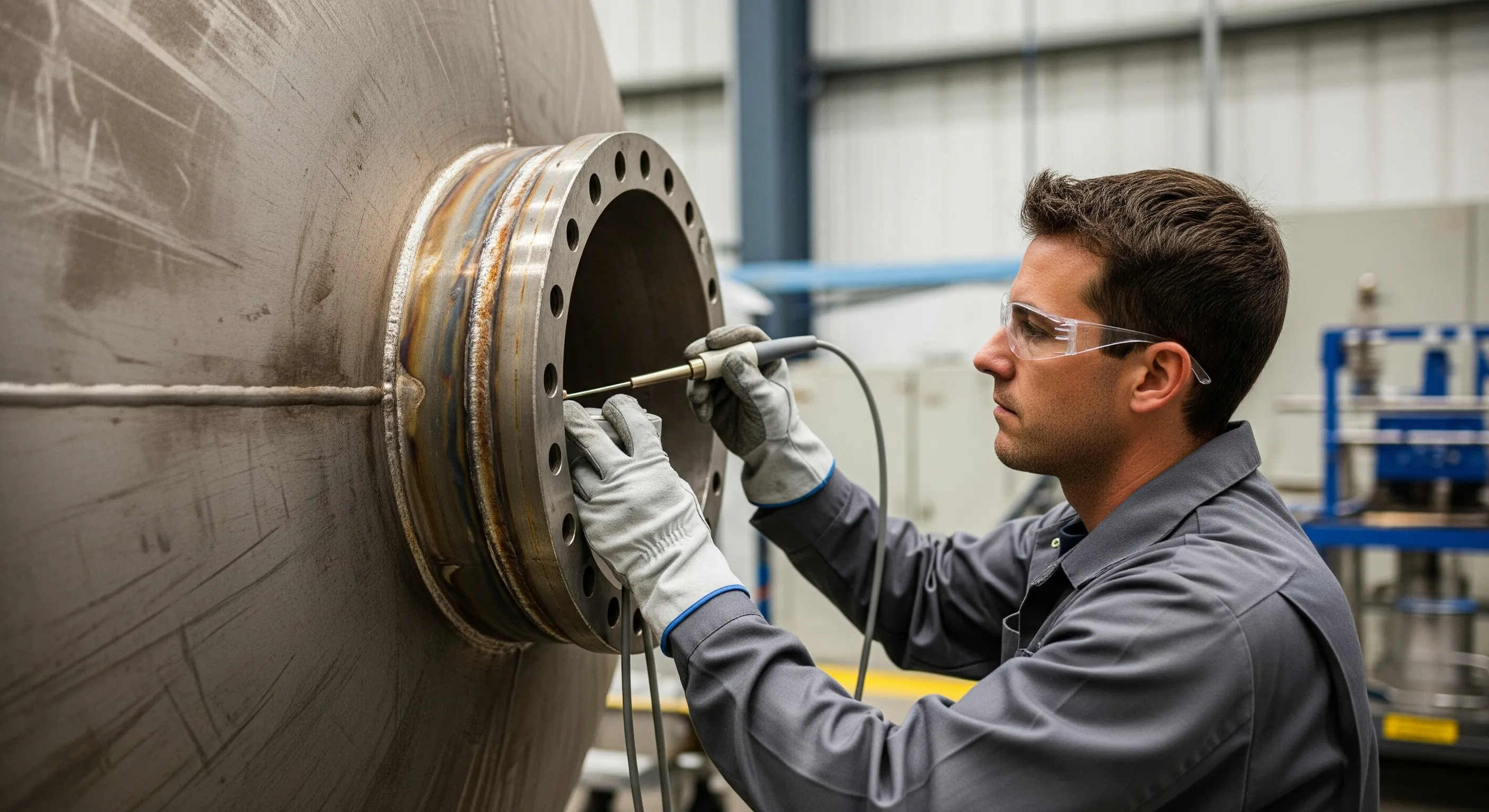
Pressure vessels, reactors, and boilers are the heart of countless industrial processes. They operate under extreme pressure and temperature conditions, making their structural integrity a non-negotiable safety factor. Inspection under the ASME code is fundamental to preventing catastrophic failures.
The ASME Boiler and Pressure Vessel Code (BPVC), specifically Section VIII, governs the design, fabrication, inspection, and testing of pressure vessels. Complying with its stipulations is both a legal requirement and an indispensable engineering practice.
Inspection of pressure vessel welds looks for volumetric and planar defects that could act as failure initiators. The primary methods are:
The Mandatory Appendices of ASME Section VIII contain detailed acceptance and rejection criteria for discontinuities detected by different NDT methods. Our Level II and Level III inspectors are highly trained to interpret and apply these complex criteria, ensuring that your equipment complies with the code and is safe to operate.
Navigating the ASME code requires experience and precision. Compañía Técnica provides that expertise, guaranteeing that your critical assets are inspected with the highest technical rigor and compliance, protecting your investment, your personnel, and your operations.
At Compañía Técnica this translates into concrete work: industrial ultrasonic testing and phased array, carried out with our own equipment, deployable anywhere in Argentina, and a report signed by a technical representative registered with the Energy Secretariat. The full catalogue of non-destructive testing sets out the scope of each one.
The code defines which welded joints must be examined and to what extent, based on the vessel type, design pressure and material. Depending on the case it may require full or spot radiography, ultrasonic testing, penetrant testing or magnetic particle testing on the welds.
The frequency follows from the assessed corrosion rate and the measured remaining thickness, plus whatever local regulation requires for the equipment. A vessel with active corrosion is inspected at shorter intervals than a stable one.
Discover how a well-planned Non-Destructive Testing program can maximize the service life of your equipment, reduce costs, and prevent unexpected failures.
Read more
Not all tests are equal. Understand why the IRAM-ISO-9712 certification of our personnel is a pillar for the reliability and precision of our services.
Read more
We are registered in the Register of Auditing Entities of the Secretariat of Energy, under categories A-I, A-II, B-I and B-II. What this means for your service station or plant.
Read more