Acoustic Emission Testing (AE)
We listen to the asset while it works: sensors pick up the elastic waves a flaw releases as it grows under load. A single test covers the whole vessel, with the equipment in service or during a load test.
- The whole asset covered in a single test
- Carried out in service or during a load test
- Locates the active zone for follow-up with a point method
- Pressure vessels, storage spheres and tanks
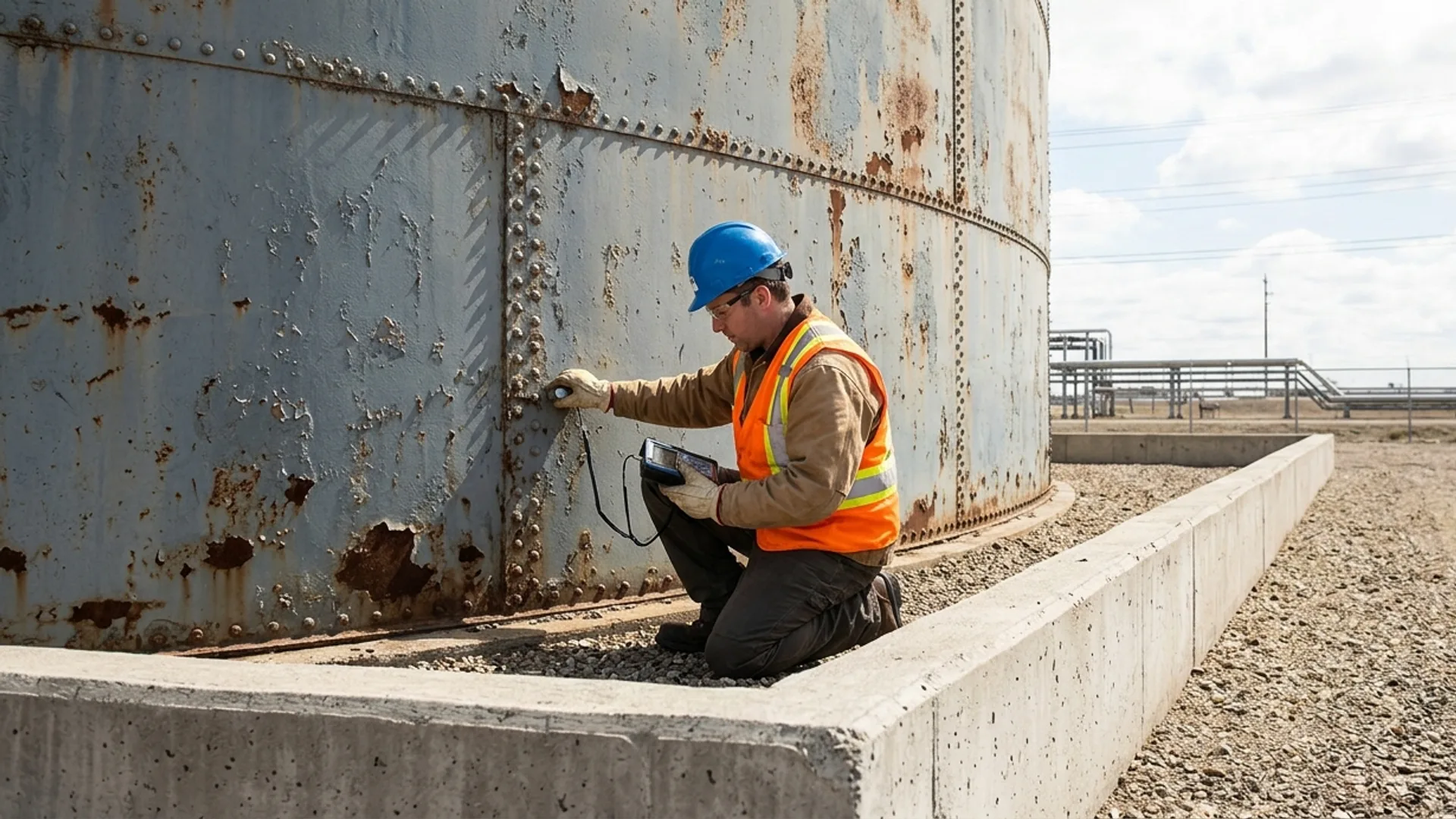
AE
In service
What is acoustic emission testing?
Acoustic emission (AE) is a passive test: the instrument injects no energy into the material, it listens. When a crack propagates, an inclusion debonds or a corrosion layer breaks under load, the flaw releases transient elastic waves that travel through the wall of the asset. Piezoelectric sensors coupled to the surface pick up those waves, typically in the 20 kHz to 1 MHz range, and the system records every event with its amplitude, its energy and its arrival time at each sensor.
The difference between those arrival times is what allows the origin of the event to be triangulated across the surface. With a distributed sensor array, one test covers the entire vessel instead of walking it point by point: the output is a map of active zones ranked by intensity, on an asset that does not need to be opened or emptied. The test runs with the equipment in service or during a controlled load test, because AE only records the flaw that grows while it is being listened to.
AE is therefore a screening test, not a sizing test: it says where to look, not how large the flaw is. The zone that shows activity is then inspected with a point method — ultrasonic testing over the weld, for example — which measures remaining thickness and characterises the discontinuity. At Compañía Técnica we run the test with personnel qualified to IRAM-ISO 9712 and deliver a report with the location and classification of every active zone.
What acoustic emission delivers
A test that covers the whole asset without taking it out of service
Global coverage
The whole asset in a single test, with a sensor array coupled to the wall.
No shutdown
Testing runs with the asset in service or during a scheduled load test.
Active zone located
The arrival time at each sensor places the origin of the event on the surface.
Report with ranked zones
Every active zone is recorded and ranked by intensity of activity.
Frequently asked questions about acoustic emission
What is acoustic emission testing?
Acoustic emission (AE) is a passive non-destructive test: piezoelectric sensors coupled to the wall of the asset pick up the elastic waves a flaw releases as it grows under load. The system records every event and, from the difference in arrival times between sensors, places its origin on the surface. It is applied to pressure vessels, storage spheres and tanks, with the asset in service or during a load test.
Does the equipment have to be taken out of service for the test?
No. Acoustic emission runs with the asset in service or during a scheduled load test, because the flaw has to be under stress in order to emit. The sensors are coupled from the outside, onto the surface of the vessel or tank, and there is no need to empty or open it. That is the main difference from methods that require internal access.
What does acoustic emission detect, and what does it miss?
It detects active flaws: propagating cracks, advancing corrosion, debonding, friction between surfaces and leaks. It does not register a stable flaw that releases no energy while it is being listened to, and it does not measure size or remaining thickness. AE is therefore used to locate the zone to inspect, while sizing is left to a point test over the zone flagged, usually ultrasonic testing.
Which assets is it applied to?
Pressure vessels, liquefied gas storage spheres, atmospheric storage tanks, columns, reactors and pipework. It is particularly useful when the asset is large or hard to access: one test covers the entire instrumented surface, whereas a point-by-point sweep would call for scaffolding, access work and shutdown time.
Which standards apply and what is delivered?
The test follows ASME Section V, which covers acoustic emission on metallic vessels during pressure testing, with personnel qualification criteria aligned with the recommended practices of ASNT and IRAM-ISO 9712. On storage tanks the result feeds into the API 653 inspection plan. The deliverable is a report giving the location of every active zone, its ranking by intensity and the point test required to verify it.
Related services
Reference standards
- ASME — boiler and pressure vessel code and welding qualification
- American Society for Nondestructive Testing (ASNT) — international reference on NDT methods and qualification
- American Petroleum Institute (API) — publisher of the API 653, API 1104 and API 579 standards